

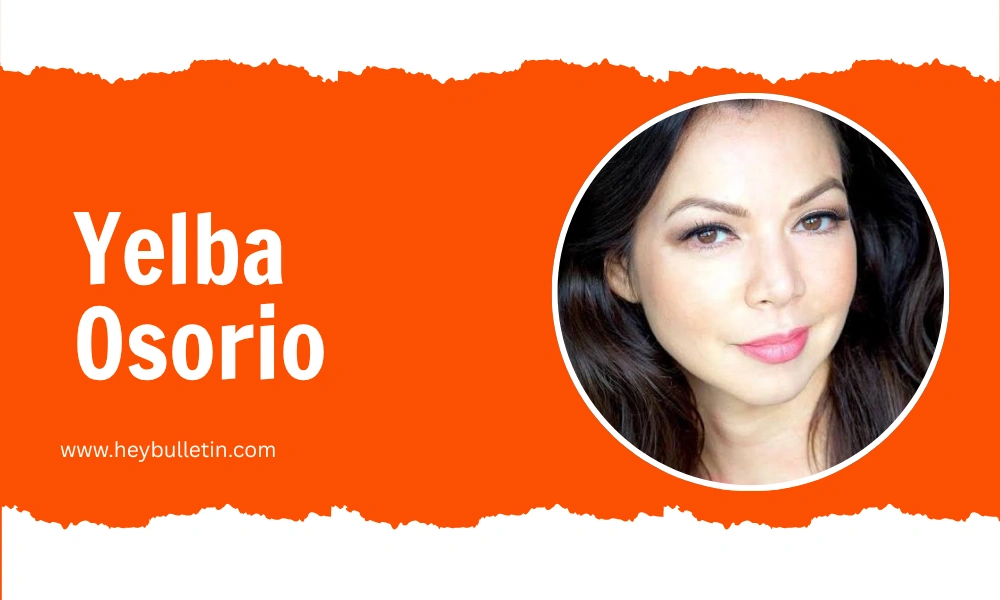
If you are talking about Yelba Osorio, the results are thin, scattered, and often contradict each other. Some pages claim she was born in New York; others say Honduras. Some say she left acting for a career in nursing; others say she’s still working today under a different name. A handful of low-quality biography sites seem to be recycling the same speculative paragraphs about her personal life, dressed up in slightly different wording each time.
This is a common problem with performers who worked steadily but never became household names. They show up in enough film and television credits to attract curiosity, but not enough to warrant a proper, well-sourced profile. Yelba Osorio is a good example of exactly that gap, a working actress with a real and traceable body of work, whose public footprint has since been filled in more by internet guesswork than by fact.
Yelba Osorio’s Early Life and Education
According to her own biography published by the American Repertory Theater (A.R.T.), Yelba Osorio was born in Honduras and raised in New York City. That combination, a Central American birth and a New York upbringing, is a detail that shows up consistently in her professional theater biography, which is generally the most reliable single source available for her early life, since it was presumably written from information she provided herself.
Her educational background is unusually academic for someone who ended up on screen. She attended Stuyvesant High School, one of New York City’s most selective public high schools, known for its rigorous math and science admissions test and its long list of notable alumni across law, science, journalism, and the arts. From there, she went on to Barnard College at Columbia University, where she earned a Bachelor of Arts in English.
It’s worth pausing on that path for a second, because it’s not the typical route into episodic television and B-movies. Stuyvesant and Barnard are both institutions associated with rigorous, traditionally academic training rather than performance. An English degree from a school like Barnard tends to produce close readers, careful writers, and people comfortable with textual analysis, skills that map onto acting more than people sometimes assume, particularly when it comes to script interpretation, character motivation, and dialogue.
Yelba Osorio’s Formal Actor Training at A.R.T./MXAT
After her academic degree, Yelba Osorio pursued formal actor training through the A.R.T./MXAT Institute for Advanced Theater Training, graduating in 2008. This program has an interesting history in American theater education. It began as an initiative connected to Harvard University and the American Repertory Theater, founded by Robert Brustein, who wanted to create a serious, professional-level actor training program despite Harvard’s traditional reluctance to house a full drama department. For years, the program operated in partnership with the Moscow Art Theatre School, and graduates during a particular stretch, roughly 1999 through 2016, received a Master of Fine Arts credential jointly from the Moscow Art Theatre School and a certificate from Harvard.
That partnership matters for understanding what kind of training Osorio received. The Moscow Art Theatre lineage traces back to Konstantin Stanislavski, whose system of actor preparation, built around given circumstances, objectives, and emotional truth, underlies most of what’s now loosely called method training in the West, even though the real Stanislavski system is considerably more disciplined and technical than the popularized American versions of it. Actors who train through MXAT-affiliated programs tend to emerge with a strong grounding in text analysis, physical specificity, and sustained ensemble work, rather than purely commercial, audition-oriented training.
While at the Institute, Osorio’s credited stage work included the role of the Lady in Tennessee Williams’ Orpheus Descending, along with the role of Karina in another production. Orpheus Descending is a demanding play by any standard, a dense, Southern Gothic tragedy about an outsider drifter who arrives in a small, closed Mississippi town and disrupts its buried tensions around race, repression, and violence. It’s the kind of text that graduate actor training programs gravitate toward precisely because it asks a lot of a performer: sustained emotional stakes, regional dialect work, and an ensemble dynamic where almost every character is hiding something. Landing the central female role in that production, within a rigorous MFA-adjacent training program, suggests she was taken seriously as a dramatic actor by the faculty evaluating her at the time; this wasn’t a program handing out lead roles casually.
Yelba Osorio’s Screen Career: A Working Actress’s Résumé
Long before her formal stage training, Yelba Osorio had already built a real, if modest, career in film and television during the 1990s and early 2000s. Her credits during that period read like a snapshot of the era’s television and independent film landscape.
She appeared in Carlito’s Way (1993), Brian De Palma’s crime drama starring Al Pacino and Sean Penn, a film now considered one of the stronger entries in the ’90s gangster-film revival, even though it underperformed at the box office on release. She also had roles connected to two long-running, prestige-adjacent network shows of the era: ER, the medical drama that helped define hospital television for over a decade, and Moesha, the UPN sitcom that made Brandy a household name and became a touchstone of Black sitcom television in the late ’90s.
Her filmography also includes a run of smaller, lesser-known projects that are easy to overlook but reflect the reality of most acting careers: plenty of work, spread across formats, rarely glamorous. These include Chespi and Ghetto Rhapsody, a role as Carmelita in the short-lived series Hollywood 7, an appearance in The Mind of the Married Man (the HBO series created by and starring Mike Binder), and a guest role as Lisa Bernstein in Strong Medicine, the Lifetime medical drama that ran for six seasons. She also appeared in the TV movie No Mothers Crying, No Babies Dying around the turn of the millennium.
One credit stands out as different in kind from the rest: Learning to Swim, a 1999 short film, where she’s credited not just as an actor but as both writer and producer. That’s a meaningful detail. Plenty of actors spend an entire career only ever standing in front of the camera; stepping behind it, even briefly and even on a short, indicates someone interested in the full mechanics of storytelling rather than just performance.
She also had a role in an episode of Walker, Texas Ranger, the long-running Chuck Norris action series, in a plot involving a young woman’s assault at a nightclub and Walker’s search for her attackers, fairly typical of the ripped from the headlines procedural plotting that defined a lot of syndicated action television in that decade.
A Surprising Yelba Osorio Credit: Sesame Street
Perhaps the most charming and unexpected item in her résumé is an appearance on Sesame Street. According to Muppet Wiki, Yelba Osorio appeared as a character named Yelba, a friend of Gina’s, in Episode 3094 of the show. For an actress whose other credits skew toward crime dramas and daytime medical shows, a Sesame Street appearance is a nice reminder of how varied a working actor’s job actually is. Getting cast on Sesame Street, even in a minor recurring-adjacent capacity, requires a very different register than a nightclub-assault subplot on Walker, Texas Ranger, warmth, simplicity, and the ability to play sincerely to the camera without irony, which is a much harder skill than it looks.
Yelba Osorio’s Personal Life: What’s Actually Documented
This is the part of Yelba Osorio’s story that generates the most search traffic and, unfortunately, the most misinformation. Here’s what’s actually well-documented, corroborated across multiple independent, reputable sources including Wikipedia and People magazine: Yelba Osorio was married to actor and comedian John Leguizamo from 1994 to 1996. The two reportedly met and were together around the time Leguizamo was filming Carlito’s Way, the same film in which Osorio had a credited role, and married in August 1994, divorcing roughly two years later.
Leguizamo has spoken about the marriage in general terms in recent years, describing it as formative to his understanding of long-term partnership, even while declining to go into detail about why it ended. He has been married since 2003 to Justine Maurer, with whom he has two children.
What’s less commonly reported, but shows up in more recent public records, is that Osorio later remarried. Industry databases now list her under the name Yelba Zoe McCourt, reflecting a marriage to Cormac McCourt in October 2018, with one child. This appears to be the name she now goes by professionally and personally, which explains part of why her older, 1990s-era credits and her more recent public presence can feel disconnected; they’re technically catalogued under two different names.
Beyond these points, there isn’t much reliable public information about her personal life, and that’s worth respecting rather than papering over. A number of low-quality websites have published speculative or outright fabricated details, invented birthdates, invented career changes, and invented fun facts, apparently generated to capture search traffic around her name rather than to inform anyone. It’s a useful reminder that not everything indexed by a search engine is true, especially for people who aren’t famous enough to have every claim about them fact-checked by a major outlet.
Why Yelba Osorio’s Career Is Worth Writing About
It would be easy to read Yelba Osorio’s résumé and conclude that it doesn’t add up to much: a scattering of guest spots, a couple of well-known titles mixed in with mostly forgotten ones, and a formal graduate-level theater credential that didn’t lead to major stage stardom. But that reading misses what’s actually interesting about it.
Most working actors, even ones who spend two or three decades in the industry, look exactly like this on paper. The entertainment industry’s mythology is built around the outliers, the household names, the franchise leads, the awards-season darlings, but the actual texture of the profession is made up of people like Osorio: performers with real training, real credits, real range (a Brian De Palma crime film, a UPN sitcom, a Lifetime medical drama, and Sesame Street, all in one filmography), who worked steadily without becoming famous, and who eventually moved on, shifted focus, or simply stopped being newsworthy enough for anyone to keep updating their public record.
There’s also something worth noting in her academic-to-arts trajectory. Stuyvesant and Barnard aren’t schools associated with a conveyor belt into showbiz, and an English degree isn’t a conservatory credential. Her later, deliberate pursuit of a rigorous, MXAT-affiliated MFA-track theater program in her late thirties, well after her most visible screen credits, suggests someone who treated acting as a craft to be studied seriously, not just a career to be aged out of or abandoned when a more marketable identity presented itself.
A Note on the Limits of the Yelba Osorio Public Record
It’s worth being direct about something: this piece deliberately leaves out a lot of what shows up when you search her name, because a meaningful amount of it doesn’t hold up. Several recently published biography pages about Yelba Osorio contain claims that contradict each other and, in some cases, contradict well-sourced reporting, different birth years, different birthplaces, invented post-acting careers, and speculative personal details presented as settled fact.
That’s not a criticism of Osorio; it’s a reflection of how thin and unreliable the internet’s coverage of moderately-known public figures can be, and a reminder that a name generating search interest doesn’t mean the information attached to it is accurate. For anyone researching a public figure who isn’t A-list famous, it’s worth checking whether a claim traces back to something concrete, an official bio, a credited role, a named and dated news source, before treating it as fact.
Conclusion
Yelba Osorio’s career is, in the end, a fairly ordinary one by industry standards, which is precisely what makes it worth documenting accurately rather than embellishing. A Honduran-born, New York-raised actress with an English degree from Barnard, formal graduate-level theater training through a Harvard- and Moscow Art Theatre-affiliated program, a genuinely varied screen résumé spanning crime drama, sitcom, medical drama, and children’s television, and a well-documented but brief marriage early in her career to a much more famous actor.
If nothing else, her story is a useful case study in how much gets lost and how much gets invented to fill the gap when a working actor’s public trail goes quiet.
Frequently Asked Questions
1. Who is Yelba Osorio?
She’s an actress born in Honduras and raised in New York City, known for 1990s and early 2000s film and TV roles, including Carlito’s Way, ER, Moesha, and a guest appearance on Sesame Street.
2. Where did Yelba Osorio study?
She attended Stuyvesant High School in New York, earned a BA in English from Barnard College at Columbia University, and later completed formal actor training at the A.R.T./MXAT Institute for Advanced Theater Training in 2008.
3. Was Yelba Osorio married to John Leguizamo?
Yes. They married in August 1994 and divorced in 1996. This is well-documented across multiple reputable sources, including Wikipedia and People magazine.
4. Was Yelba Osorio married to John Leguizamo?
Yes. Multiple reputable sources, including People magazine and Wikipedia, confirm the two married in August 1994 and divorced in 1996. Leguizamo has since been married to Justine Maurer since 2003.
5. What are her most notable roles?
Her most recognizable credits are Carlito’s Way (1993), guest roles on ER and Moesha, and an appearance as Yelba on Sesame Street. She also wrote and produced the 1999 short film Learning to Swim.
