

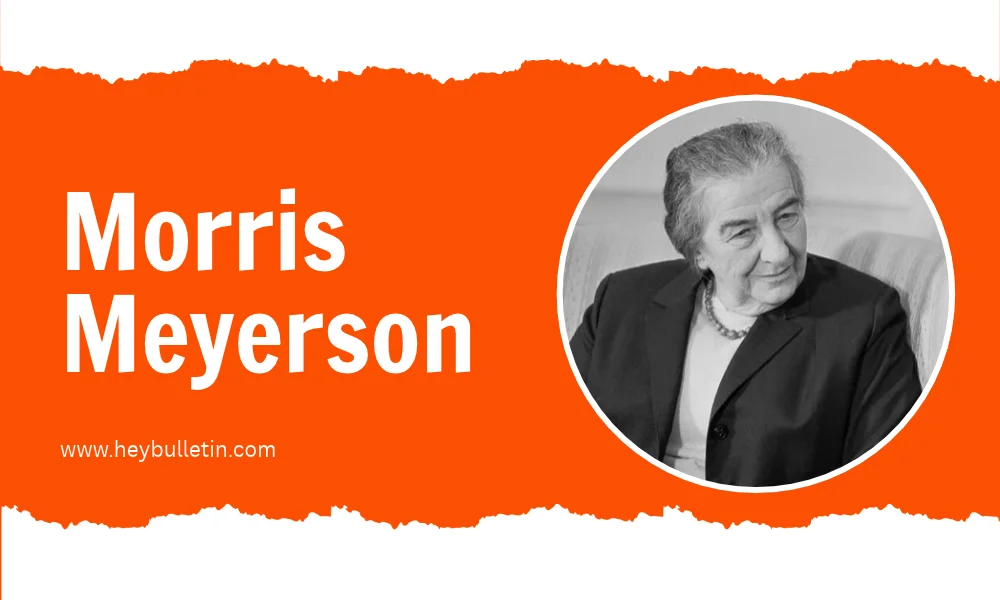
Morris Meyerson was a sign painter, a socialist, and the husband of Golda Meir, the woman who would become Israel’s fourth prime minister. Born into a world of books, music, and quiet craft, he met Golda through the debates of a Denver household, married her in 1917, and followed her to Mandatory Palestine in 1921. Life on a kibbutz proved a hard fit, and as her career in the labor movement grew, the two spent more and more time apart, though they never divorced. This post tells the story of Morris Meyerson’s marriage, his years in Jerusalem as a bookkeeper and father, his children, Menachem and Sarah, his death in 1951, and why the gentleman behind a famous name still deserves attention.
Morris Meyerson: The Man Himself
Morris Meyerson was a sign painter and a socialist. His surname is sometimes spelled Myerson, and the spelling varies across biographies and records. He is believed to have been born on December 17, 1893, in the United States, though details of his early life are thin and the record is patchy. What stays consistent across the telling of his life is his character: a gentle, bookish, music-loving man who valued a quiet private life.
That temperament matters, because it set him apart from nearly everyone in the political circles that later defined his wife’s world. He loved poetry and music, and he is also described as an aspiring engineer. He was no firebrand. He was a thoughtful, self-educated working man with an appetite for culture and little appetite for the spotlight.
A sign painter in the early twentieth century practiced a real craft: lettering by hand, mixing paint, working with steady hands and a good eye. It is easy to imagine that the same patience and sensitivity that went into his work also shaped how he approached life, deliberately, quietly, and with an eye for beauty.
How Morris Meyerson Met Goldie: Milwaukee, Denver, and the Politics of Courtship
To understand how Morris met his future wife, you have to understand the world young Golda Mabovitch had stepped into. Born in Kyiv in 1898, she grew up in Milwaukee after her family emigrated. As a teenager, she left for Denver to live with her older sister, Sheyna Korngold.
The Korngold household became the center of her political awakening. The Korngolds hosted intellectual evenings at their home where Golda was exposed to debates on Zionism, literature, women’s suffrage, trade unionism, and more. The home worked like a salon for working-class Jewish immigrants, with regular political meetings. It was in this world of impassioned talk that she met Morris Meyerson.
Morris handed her long lists of books to read, as biographer Pnina Lahav recounts. That detail says a great deal about the relationship’s beginnings. Golda was in her mid-teens; Morris was several years older and, by all accounts, an enthusiastic mentor. She fell for him at socialist meetings while she was only sixteen. Their courtship was conducted through books, music, long conversations, and, later, letters.
Their bond was real and intellectual. Morris Meyerson offered something a young woman hungry for ideas could cherish: attention, patience, and a window into literature and art. But even in these early days, a fault line was visible. He shared her socialist leanings, but not necessarily her burning commitment to Zionism.
Marriage to Morris Meyerson and the First Fault Line
Golda and Morris married on December 24, 1917. By then, she had made clear that her ultimate goal was to settle in Palestine and help build a Jewish homeland. She married him knowing he was far less enthusiastic about Zionism than she was.
This is the central tension of the Morris Meyerson story. Golda knew, and he knew, that they wanted different things from life. She wanted to build a nation. He wanted, as best anyone can tell, a peaceful home, steady work, and time for music and reading. Neither goal was wrong, and love did not make them compatible.
In the months after the wedding, Golda threw herself into fundraising for the Labor Zionist movement, Poalei Zion, traveling the country to speak. She sent letters home to Morris from across the United States during these trips. Already, the pattern that would define their marriage was forming: Golda out in the world, Morris waiting at home.
Morris Meyerson’s Journey to Palestine
For several years, Golda pressed the case for emigration. Morris, for his part, eventually went along. In 1921, the couple immigrated to Mandatory Palestine, traveling from New York to Italy on the USS Pocahontas as part of the journey. They arrived during what historians call the Third Aliyah, a wave of idealistic Jewish immigration marked by hardship, labor, and dreams of rebuilding Jewish life on the land.
It is worth pausing on what this meant for Morris Meyerson. He was leaving a country where he had family, a trade, and a familiar world, to follow his wife to a place with limited infrastructure, extreme heat, disease, and an uncertain political future. It was an act of love, and arguably of considerable courage, even if his heart was not in the cause the way hers was.
Morris Meyerson at Kibbutz Merhavia: A Hard Fit
The couple settled at Merhavia, a kibbutz in the Jezreel Valley. For Golda, the kibbutz embodied an ideal. For Morris Meyerson, it was something closer to an endurance test.
He struggled with the harsh living conditions and the lack of privacy. Kibbutz life in the early 1920s was communal in the extreme: shared labor, shared meals, little personal space. For a quiet man who treasured solitude and music, this was a difficult environment. He also contracted malaria, which made the situation worse.
There was also a deeper objection. The move away from the kibbutz was prompted in part by Morris’s dislike of the idea of raising their child in the care of a collective. Many kibbutzim at the time raised children communally, apart from their parents. Whatever one thinks of that model, it clearly conflicted with Morris’s vision of family.
Golda, meanwhile, was reportedly thriving in some ways and chafing in others. Biographers describe a growing sense of suffocation and resentment in her during this period. So both spouses, in different ways, found the ideal less perfect than imagined, and they reached the same practical conclusion: it was time to leave.
Life in Jerusalem: Morris Meyerson’s Family and Daily Struggle
The couple moved to Jerusalem. This chapter of Morris Meyerson’s life is perhaps the happiest, or at least the most stable. He worked as a bookkeeper while Golda took on jobs to help make ends meet. Their two children were born in these years: Menachem on November 23, 1924, in Jerusalem, and Sarah on May 17, 1926.
Imagine the household: a modest home in Mandate-era Jerusalem, a father who kept the books, a mother with increasingly large ambitions, and two small children. Morris was the steady presence, the parent who was there. Menachem would grow up to become a gifted cellist, and the musical sensibility in the family almost certainly owes something to his father’s love of music, though that is a reasonable inference rather than a documented fact.
Yet financial strain and Golda’s restlessness continued to push at the marriage. Golda took a job despite her husband’s disapproval. This was an era when a woman working outside the home, especially in a public role, was still unconventional. Morris’s disapproval, whatever its roots, reflects the gap between a traditional expectation of home life and the path Golda was already choosing.
Golda’s Rise and the Widening Distance from Morris Meyerson
By the late 1920s, Golda’s work with the labor movement was becoming a career. In 1928, she was elected secretary of Moetzet HaPoalot, the Working Women’s Council. The job demanded travel, meetings, and a presence in Tel Aviv, the center of the labor movement’s activity.
Because of her work, Golda and the children moved to Tel Aviv, while Morris remained in Jerusalem and visited only on weekends. This arrangement effectively ended their daily marriage. By 1930, it was clear that Golda’s passion for politics and for the ideal of Israel was greater than Morris’s, and although they remained nominally married, they spent increasing periods apart. Their formal separation is usually dated to 1940.
It is easy to cast this as a story of abandonment, with Golda as the careerist and Morris as the wounded party. The reality was more complicated. Both made choices, and neither seems to have acted out of malice. Morris Meyerson would not follow her into public life, and Golda would not retreat from it. The marriage did not so much collapse as stretch until it no longer functioned as a shared household.
The Question of the Name: Meyerson Becomes Meir
The name itself tells part of the story. In the years of their marriage, Golda was known as Golda Meyerson. She only became Golda Meir later. The change came in 1956 when, as a senior government minister, she Hebraized her surname, a practice encouraged among Israeli officials at the time. She was known as Goldie Meyerson (or Myerson) after her marriage and as Golda Meir from 1956.
The name change has a quiet poignancy. Morris Meyerson, who had never wanted to be a public figure, had given his surname to a woman who would eventually shed it for a Hebrew one that suited her country’s national mood. His name faded from her public identity, though she never divorced him, and their children carried the Meyerson name in their early years.
The Complicated Personal Landscape of the Morris Meyerson Marriage
No honest account of Morris Meyerson can ignore the more painful dimensions of the marriage. Pnina Lahav’s biography describes a relationship between Golda and the labor leader Zalman Remez that lasted roughly two decades, until his death in 1951. Golda and Morris never divorced.
Historians and biographers approach this subject with varying degrees of delicacy, and it is worth saying clearly that much of what we know about the private emotional lives of public figures comes filtered through memoirs, interviews, and the interpretations of biographers. Morris left no memoir of his own, so his perspective has to be inferred from the accounts of others, including his wife’s autobiography and his son’s reflections. That asymmetry matters. The person who might best tell his side of the story is the one least heard.
What can be said with reasonable confidence is that Morris Meyerson remained in Jerusalem, remained legally married to Golda, and remained part of his children’s lives. It is not the portrait of a villain or a victim, but of a man who accepted a diminished role in a marriage that no longer worked in the conventional sense.
Death and Legacy of Morris Meyerson
Morris Meyerson died of a heart attack on May 25, 1951. He died only a few days after Zalman Remez, at the age of 57. The coincidence of those two deaths in the same week must have been a heavy moment for Golda, who lost both the man she had married and the man with whom she had shared a long relationship.
Morris did not live to see his wife become foreign minister in 1956, or prime minister in 1969, or to witness the Yom Kippur War of 1973 that would shadow her legacy. He was not there for the global fame, the criticism, or the eventual reassessment of her career. In a sense, he belongs to the earlier, quieter chapter of her life, the immigrant years, the kibbutz years, the years of two young children and a modest apartment.
His legacy lives on most visibly through his children. Sarah Meyerson later lived on a kibbutz and raised a family there. Menachem pursued a music career. He graduated from the Manhattan School of Music in New York, performed at Carnegie Recital Hall, and wrote a book about his mother. In that sense, the sign painter’s love of music found its way into the next generation.
Why Morris Meyerson Still Matters
Why should anyone care about the husband of a famous woman? There are several reasons.
He complicates the myth. Public memory often flattens great figures into symbols. Golda Meir is remembered as the grandmotherly stateswoman, the strong-willed lioness, the leader during a national crisis. Morris reminds us that she was also a young immigrant, a wife, and a mother making difficult choices with real costs to the people closest to her.
He represents a road not taken. A life of reading, music, craft, and quiet family time was an entirely legitimate way to live, and Morris chose it, even when it meant being out of step with the era’s grand ideological projects. Not everyone who lived through the founding of Israel wanted to be a founder.
He raises questions about partnership and ambition. The Meyerson marriage forces a modern reader to think about what happens when two people with different callings try to build one life. There is no tidy moral. Golda’s drive helped shape a country; Morris’s reluctance may have preserved something for their children that a more chaotic household would not have. Both things can be true.
He reminds us how much history goes unrecorded. Most of what we know about Morris Meyerson is secondhand. Entire lives, especially quiet ones, slip through the archives. Writing about him is partly an exercise in humility about what we cannot know.
Further Reading on Morris Meyerson
If you want to go deeper than this overview, a few starting points stand out. Golda Meir’s own autobiography, My Life, offers her perspective on the marriage, with the usual caveats about self-presentation in memoirs. Francine Klagsbrun’s Lioness: Golda Meir and the Nation of Israel (2017) is a comprehensive modern biography. Pnina Lahav’s The Only Woman in the Room: Golda Meir and Her Path to Power offers a more recent scholarly treatment. Menachem Meyerson’s own book about his mother provides the perspective of someone who lived inside the family.
A note on the record: some details of Morris’s life, such as his birth and the exact timeline of the separation, vary from one telling to the next. Where specifics matter, a published biography is the safest guide.
Conclusion
Morris Meyerson never sought fame, and history has granted him only a supporting role. Still, he was the first great love of a woman who would change the course of a nation, a partner in the exhausting early years of immigration, and a father who raised two children in a difficult time and place. He loved books, music, and craft, and he preferred a quiet life to a historic one.
When we remember Golda Meir, we owe it to the full story to remember Morris too: not as a footnote, but as a reminder that behind every public life stands a web of private ones, shaped by love, compromise, and the unavoidable cost of choosing one path over another.
Frequently Asked Questions
Who was Morris Meyerson?
Morris Meyerson was a sign painter and socialist, best known as the husband of Golda Meir, who later became Israel’s fourth prime minister. He was a quiet, music-loving man who preferred a private life to a public one.
When did Morris Meyerson and Golda Meir get married?
They married on December 24, 1917. They had met years earlier through the socialist circles around her sister’s home in Denver, and they emigrated to Mandatory Palestine together in 1921.
Did Golda Meir and Morris Meyerson ever divorce?
No. They lived apart for most of their later years, and their formal separation is usually dated to 1940, but they never divorced. Morris stayed in Jerusalem while Golda lived and worked in Tel Aviv.
Did they have children?
Yes, two. Menachem was born in 1924 and became a cellist and musician. Sarah was born in 1926 and lived on a kibbutz.
How did Morris Meyerson die?
He died of a heart attack on May 25, 1951, at the age of 57. His death came only a few days after that of Zalman Remez, the labor leader with whom Golda had a long relationship.
