

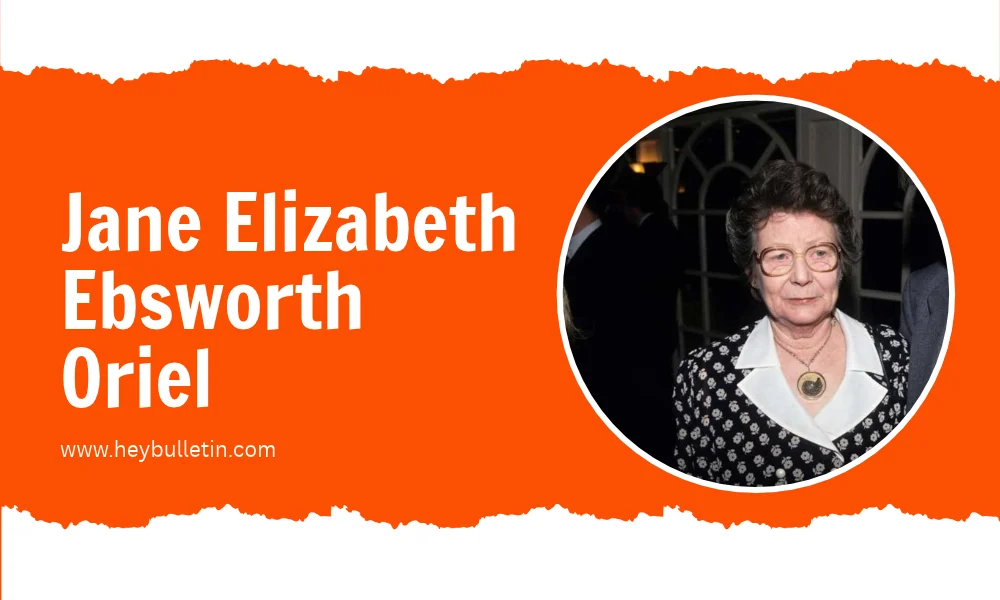
Jane Elizabeth Ebsworth Oriel was born in 1926 and married broadcaster Sir David Attenborough in 1950. Over nearly five decades, she kept the family steady while his work took him to some of the most remote places on Earth, and she raised their two children, Robert and Susan, largely out of the public eye. This post sets out what is reliably known about her: her family background, the marriage, the years of absence during the Zoo Quest era, and her death from a brain haemorrhage in 1997. It also separates fact from the contradictory and invented claims that circulate online, including the wholly mistaken idea that she was a nineteenth-century philanthropist, and ends with five clear, direct answers about her marriage, children, death, and legacy.
Who Was Jane Elizabeth Ebsworth Oriel?
Jane Elizabeth Ebsworth Oriel was born in 1926, the same year as her future husband. She was the daughter of John Augustus Oriel, whose career is recorded in the honours he held (a CBE and a Military Cross), and his wife Margaret. The full combination of names, Jane Elizabeth Ebsworth Oriel, appears in biographical references to her marriage, which is why it has become the name people use for her.
Beyond that, the picture gets fuzzy. Some websites say she was born in Wales; others say Middlesex. Some say she studied at Cambridge, but no reliable source I could find confirms it, and the claim that she and David met there is likewise unconfirmed. Several pages give her age at death as 70 and others as 77, though a birth in 1926 and a death in early 1997 point to 70.
This is common for people who lived private lives alongside famous spouses. When someone never gave interviews, never wrote a memoir, and never courted attention, the public record stays thin, and content farms fill the gap with guesses dressed up as fact. A responsible biography has to be willing to say this is not known where that is the truth.
Jane Elizabeth Ebsworth Oriel and the Marriage That Began in 1950
What is well established is that Jane Oriel married David Attenborough in 1950. They were both in their early twenties. David had come out of Clare College, Cambridge, where he studied natural sciences, and had done national service in the Royal Navy. He was, at that point, a young man without a clear career. He briefly worked in educational publishing, and the later BBC fame was still ahead of him.
That timing matters. Jane did not marry a celebrity. She married a young man with a passion for the natural world and an uncertain future, and she was there through the entire arc of what followed. Their marriage lasted until her death in 1997, close to five decades.
Many biographical profiles of famous men treat the wife as a footnote: a date of marriage, some children, a date of death. Jane Elizabeth Ebsworth Oriel deserves better than that, even when the surviving details are modest. The early years of a marriage are when the groundwork for a career is laid, and a spouse’s tolerance for risk, absence, and uncertainty is part of that groundwork.
The World Jane Elizabeth Ebsworth Oriel’s Husband Was Building
To appreciate the role of Jane Elizabeth Ebsworth Oriel, it helps to understand what David was doing during their marriage, because the work shaped family life.
David joined the BBC in 1952 as a trainee producer. He was initially assigned to talks programmes, but his enthusiasm for animals soon led to something new. In 1954 he began Zoo Quest, a series in which he travelled to remote places to capture rare animals for London Zoo and film them in the wild. These were genuine expeditions to Africa, South America, Southeast Asia and the Pacific, and they often meant weeks or months away from home. The 1956 trip to Indonesia, which brought Komodo dragons to British television audiences, is among the best remembered.
In the 1960s he moved into management. He became Controller of BBC Two in 1965, a role in which he oversaw the introduction of colour television to Britain and commissioned an extraordinary range of programmes, from landmark arts and history series to comedy and sport. Colour broadcasting on BBC Two began in 1967, and he championed programming that would show it off, including snooker, which turned out to look striking in colour. In 1969 he became the BBC’s Director of Programmes, one of the most senior positions in British broadcasting, and it was during this period that a surreal new comedy show called Monty Python’s Flying Circus reached the screen.
Then in 1972 he gave up the executive career to return to making programmes himself.
That decision led to the series most people associate with him: Life on Earth in 1979, The Living Planet in 1984, The Trials of Life in 1990, and on through The Private Life of Plants and The Blue Planet. He was knighted in 1985. By the time Jane died, he was already regarded as a national institution.
It is worth pausing on the choice made in 1972. Walking away from a top BBC post to go back to filming in remote locations was a big professional gamble, and it also meant a life with more travel. A decision like that is never made by one person alone in a marriage. The acceptance of that way of life by Jane Elizabeth Ebsworth Oriel is part of the reason the career looks the way it does.
Jane Elizabeth Ebsworth Oriel at Home During the Zoo Quest Years
It is easy to read the Zoo Quest era as an adventure story: a young presenter, a camera crew, rivers and jungles and strange animals. Viewed from the other end of the telephone line, or more likely the other end of a long delay in letters, it looks different.
In the 1950s there was no mobile phone, no video call, no instant message. An expedition to the other side of the world meant genuine silence. A wife at home, newly a mother, would learn what had happened only when the person returned or when a message eventually found its way back. That kind of marriage requires trust of a quiet and demanding sort.
Nothing in the surviving public record describes how Jane Elizabeth Ebsworth Oriel experienced those years, and it would be dishonest to invent her thoughts. But the structure of the situation is clear enough. The expeditions that made her husband famous depended on a household that could function without him, and that household was hers to run.
How Jane Elizabeth Ebsworth Oriel Raised Robert and Susan
Jane Elizabeth Ebsworth Oriel and David had two children, Robert and Susan. Robert went on to an academic career, and Susan became a school headteacher. Neither pursued the kind of public life their father led, and that seems consistent with the family’s general preference for privacy.
Because David’s work took him away for long stretches, particularly in the Zoo Quest years and again during the major natural history series, much of the day-to-day work of raising two children fell to Jane. Every family with a frequently absent parent knows what that means: school runs, illnesses, homework, birthdays, and the quiet management of a household that has to function whether or not the famous person is in town.
It is a common pattern, and it is rarely recorded. History tends to preserve the expeditions and the broadcasts and forget the person who made the base camp at home viable. That imbalance is part of why Jane Elizabeth Ebsworth Oriel is so hard to pin down. The work she did was real and sustained, but it was not the kind that generates archives.
Partnership in Absence
Long absences test a marriage. A husband who travels to the world’s most remote places for months at a time, and who is often in danger or at least in discomfort, asks a lot of a wife. He also depends on her. The ability to go to the Amazon, the Antarctic, or the deep ocean with a clear mind relies on knowing that home is stable.
Attenborough has spoken warmly about his wife in later interviews, and descriptions of Jane Elizabeth Ebsworth Oriel from those who knew her point to a steady, supportive presence. I would caution against the more florid claims online, such as that she was his muse or advisor on specific programmes. Those descriptions sound plausible but are not backed by sources I could verify. What can be said responsibly is simpler: she was his wife of nearly fifty years, and the stability of their family life was a precondition for the career he had.
The Loss of Jane Elizabeth Ebsworth Oriel in 1997
Jane Elizabeth Ebsworth Oriel died in February 1997, after suffering a brain haemorrhage. Reports describe it as sudden. Accounts say David was away at the time and returned home quickly, but by then she was gravely ill, and she died shortly afterward.
For a man who had built a life around observing the cycles of living things, the loss was an intensely personal one. He has spoken publicly about the grief of losing Jane and has said that the loss was profound. He continued to work, and some of his best-known later projects, including The Blue Planet, came afterward. But work is not the same as recovery, and it would be wrong to read his continued productivity as a sign that her death was anything other than devastating.
Attenborough’s later reflections on mortality, on the fragility of the natural world and on what we owe to future generations carry a different weight when you remember that they came from someone who had lost his partner of almost fifty years.
Why So Much Misinformation Surrounds Jane Elizabeth Ebsworth Oriel
Look for Jane Elizabeth Ebsworth Oriel online and you will find dozens of near-identical pages promising a complete biography with her height, net worth and social media accounts. Several make claims that cannot be true. One describes her as a nineteenth-century social reformer who lived from 1819 to 1904, which has nothing to do with the woman who married David Attenborough. Others quote net worth figures for a person who lived a private family life and held no public career.
This is a modern phenomenon. Public curiosity about a famous person’s spouse creates demand, and automated or lightly edited pages rush to supply content even when the facts are not available. The result is a pile of pages that repeat each other, contradict each other, and rarely cite anything.
A few simple habits help when you run into this kind of material:
- Check for primary sources. Reliable biographies of David Attenborough, obituaries, and archived news coverage are better guides than aggregator sites.
- Notice contradictions. If one page says she was born in Wales and another says Middlesex, at least one is guessing.
- Be suspicious of precision without citation. Exact net worth figures for a private individual are a red flag.
- Accept gaps. For many people, especially women of Jane’s generation who lived outside public life, the honest answer to some questions is that the record is sparse.
The Legacy of Jane Elizabeth Ebsworth Oriel
Jane Elizabeth Ebsworth Oriel did not leave a body of published work, a public cause or a set of famous quotations. Her legacy is less visible but no less real.
It lives first in her family. Robert and Susan carry forward a family culture of curiosity and public service, in academia and education respectively.
It lives, indirectly, in the broadcasting her husband made. A great deal of what the world understands about wildlife, ecosystems and conservation reached audiences through his programmes. Those programmes were made possible by a long, stable partnership. Crediting her with their content would be inaccurate, but acknowledging that she was part of the foundation they stood on is fair.
And it lives in a broader lesson about how we tell stories of achievement. We tend to attribute success to one celebrated individual, when most lives of consequence rest on networks of support that go unrecorded. Remembering Jane Elizabeth Ebsworth Oriel is a small way of correcting that habit.
Conclusion
Jane Elizabeth Ebsworth Oriel was born in 1926, married David Attenborough in 1950, raised their two children, Robert and Susan, and died in 1997 after a brain haemorrhage. That is the reliable core of her story. The rest, much of what circulates online, is speculation, contradiction or outright invention.
Rather than filling the gaps with plausible-sounding detail, the better tribute is to be honest about what we know. She was the steady presence in the life of one of the twentieth century’s most influential communicators, and she lived that role privately and, by all appearances, by choice. If you want to learn more, look to authoritative biographies and obituaries of David Attenborough, and to his own interviews, where he has spoken about her with evident affection.
Frequently Asked Questions
Who was Jane Elizabeth Ebsworth Oriel?
Jane Elizabeth Ebsworth Oriel was born in 1926 and became Jane Attenborough when she married broadcaster and naturalist David Attenborough. She was the daughter of John Augustus Oriel and his wife Margaret, and she lived a largely private life away from the public attention her husband attracted.
When did Jane Elizabeth Ebsworth Oriel marry David Attenborough?
They married in 1950, when both were in their early twenties. The marriage lasted until she died in 1997, a span of nearly fifty years.
Did Jane Elizabeth Ebsworth Oriel have children?
Yes. She and David had two children, Robert and Susan. Robert pursued an academic career, and Susan became a school headteacher.
How did Jane Elizabeth Ebsworth Oriel die?
She died in February 1997 after a brain haemorrhage. Reports describe the illness as sudden, and say that David returned home quickly after learning she was unwell.
Was Jane Elizabeth Ebsworth Oriel a nineteenth-century philanthropist?
No. Some websites describe a Jane Elizabeth Ebsworth Oriel who lived from 1819 to 1904 and campaigned for social reform, but that description is not connected to the woman who married David Attenborough. The Jane Elizabeth Ebsworth Oriel discussed in this post was born in 1926 and died in 1997.
