

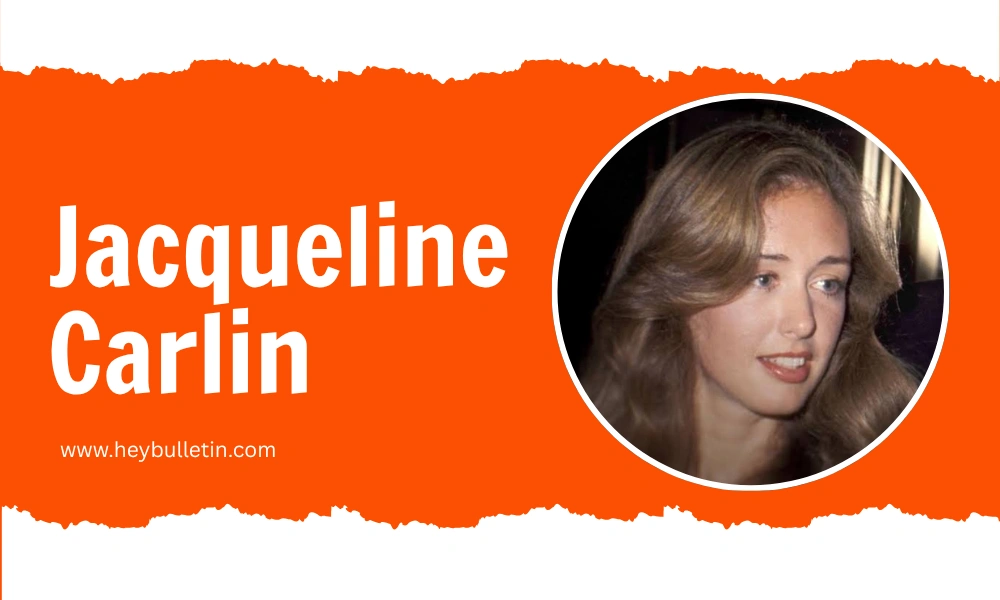
When people talk about the early days of Saturday Night Live, the conversation almost always circles back to the same handful of names: John Belushi, Chevy Chase, Gilda Radner, Dan Aykroyd, and Lorne Michaels. These were the performers who turned a scrappy late-night sketch show into a cultural institution, and their legacies have been picked apart, celebrated, and mythologized for nearly fifty years. But tucked into the footnotes of that history is a name that rarely gets its due: Jacqueline Carlin.
Carlin holds a small but genuinely historic distinction: she was the first woman to appear on screen in the history of Saturday Night Live. That alone would be enough to earn her a permanent, if modest, place in television trivia. But her life extended well beyond that one flickering moment on a black-and-white studio monitor in 1975. She was a model, an actress, a wife to two prominent men in entertainment, a stepdaughter-in-law to one of Hollywood’s most beloved stars, and, in her later decades, a savvy entrepreneur who built a second career in real estate and hospitality. This post traces her story from a New Jersey childhood to a night in 30 Rockefeller Plaza that made her a footnote in comedy history, and onward to the quieter, resilient life she built afterward.
Jacqueline Carlin’s Early Life in New Jersey
Jacqueline Carlin was born on November 20, 1942, in Caldwell, New Jersey, a small suburban town not far from Newark that would later gain its own footnote in political history as the birthplace of President Grover Cleveland. She grew up as the second oldest of four siblings in a close Catholic family, attending Saint Aloysius grammar school in Caldwell before moving on to Mount Saint Dominic Academy for her secondary education. From there, she went south to Immaculata College in Washington, D.C., a Catholic women’s college, to continue her studies.
Details about her childhood are sparse in the public record, which is fairly typical for a woman who became a public figure through modeling and acting rather than through an early, well-documented rise to fame. What is clear from those who knew her, and from the way her life unfolded afterward, is that she carried a strong sense of identity and independence from an early age, traits that would come to define both her television-era appearances and her later business ventures.
From the Runway to the Studio: Jacqueline Carlin’s Modeling Career in New York
After finishing her education, Carlin made the move that so many ambitious young women with striking looks and a sense of adventure made in that era: she headed for New York City. There, she signed with the Ford Modeling Agency, one of the most prestigious modeling houses in the world at the time, representing some of the most recognizable faces in American fashion throughout the 1960s and ’70s.
Modeling in New York during this period meant rubbing shoulders with photographers, magazine editors, and the wider entertainment industry that was increasingly blurring the line between fashion and celebrity. It was a natural stepping stone for many models of the era to transition into television and film work, and Carlin was no exception. Her work in front of the camera for fashion clients gave her both the polish and the industry connections that would eventually lead her toward acting.
A Footnote That Became History: Jacqueline Carlin and Saturday Night Live
In October 1975, a new late-night sketch comedy show debuted on NBC. It had almost no track record, a cast of relatively unknown comedians, and a time slot most networks would have considered a graveyard. That show was NBC’s Saturday Night, soon to be renamed Saturday Night Live, and it would go on to become one of the most influential programs in the history of American television.
Carlin appeared in the show’s very first season, and specifically in the October 11, 1975 episode, in a sketch titled New Dad. That appearance made her the first woman to appear on screen in the show’s history, predating the far more famous female cast members and hosts whose names would later become synonymous with the program. It is a small, almost trivial-sounding fact, but it carries real weight for television historians: in a show that would eventually be criticized for decades over its gender balance both in front of and behind the camera, the very first face audiences saw belonged to a woman largely forgotten by mainstream retrospectives.
Carlin didn’t stop there. Over the course of SNL’s first season and into its second, she made cameo appearances across roughly seven episodes, typically in small supporting roles rather than as a credited or recurring cast member. This wasn’t unusual for the show’s earliest days; the original Saturday Night Live frequently used friends, acquaintances, and industry contacts of the cast and writers to fill out sketches, long before the show’s audition and casting process became the rigorous institution it is today. Carlin’s connection to the show almost certainly ran through her relationship with one of its breakout stars: Chevy Chase.
Beyond SNL: Jacqueline Carlin’s Television and Film Work
While Saturday Night Live remains her best-known credit, Carlin’s on-screen résumé extended into other corners of 1970s television and film. She appeared in Bronk, a short-lived 1975 detective drama starring Jack Palance, and she had a role in the 1978 disco-era film Thank God It’s Friday, an ensemble comedy that captured the nightclub culture of the period and featured a soundtrack stacked with hits from Donna Summer and other disco acts of the era.
She was also a recurring presence on The Tonight Show Starring Johnny Carson, appearing as a guest across multiple episodes throughout the 1960s and into the following decade. At a time when Carson’s desk was the single most influential platform in American entertainment, appearing there, even in a lighter, non-comedic capacity, was a meaningful marker of a person’s standing in the industry.
Taken together, her acting credits don’t amount to a leading-lady filmography. She was never a headline star, and she likely never aspired to be one in the way her more famous SNL castmates did. But her presence across several of the defining pop-culture touchstones of the 1970s, the birth of SNL, the disco film boom, and the Carson-era late-night landscape, places her squarely inside the cultural moment, even if she stood slightly outside the spotlight’s brightest circle.
Jacqueline Carlin’s Marriage to Chevy Chase
Carlin’s most widely documented personal relationship was her marriage to Chevy Chase, the Saturday Night Live original cast member who would go on to become one of the most recognizable comedic actors of his generation, later starring in National Lampoon’s Vacation, Fletch, and Caddyshack. The two were married from 1976 to 1980, meaning their union coincided almost exactly with Chase’s meteoric rise to fame, his time as a Weekend Update anchor, his early departure from SNL to pursue film work, and his first steps toward Hollywood stardom.
Photographs from the period capture the couple at some of the era’s most glamorous events: the 1976 premiere of A Star Is Born at Mann’s Village Theater in Westwood, the Robert F. Kennedy Pro-Celebrity Tennis Tournament, and the Governors Ball following the 49th Academy Awards. These images, many of which circulate through entertainment archives today, show a young couple navigating the strange new terrain of sudden fame, Chase newly minted as a household name, Carlin standing beside him as both partner and, in her own right, a familiar face from the same show that had made him famous.
The marriage ended in 1980, a fairly common outcome for relationships forged in the accelerant of overnight celebrity. Chase would go on to marry twice more, while Carlin’s own path led her toward a second high-profile marriage, this time to a man connected not to comedy but to music.
Jacqueline Carlin’s Marriage to Terry Melcher and a Connection to Doris Day
After her marriage to Chase ended, Carlin married Terry Melcher, a record producer best known for his work with The Byrds and Paul Revere & the Raiders, and for his complicated historical footnote as the man whose former Cielo Drive residence was later the site of the Tate murders, a property Melcher had vacated before Charles Manson’s followers targeted it. Melcher was also notable for another reason entirely: he was the son of legendary actress and singer Doris Day.
Carlin and Melcher had a son together, Ryan Melcher, born in 1983. Through this marriage, Carlin became Doris Day’s daughter-in-law, linking her, at least by family connection, to one of the most beloved and enduring stars of American film and music. The relationship between Carlin and Melcher would prove to be lasting in a way her first marriage had not; the two remained connected for the rest of Melcher’s life, and their shared business ventures in later years, particularly in Carmel, California, became deeply intertwined with the Day family’s own history in the area.
Terry Melcher died in 2004, and Doris Day continued living in Carmel until her own death in 2019. Carlin, meanwhile, carried forward the family’s presence in the town for years afterward.
A Second Act: Jacqueline Carlin in Real Estate and Hospitality
Where many former models and actresses of her generation faded from public life once their entertainment careers wound down, Carlin instead built a substantial second career. She became involved in property development and hospitality, buying and developing real estate on Martha’s Vineyard, including an oceanfront home, and later putting down deeper roots in Carmel-by-the-Sea, California, a picturesque coastal town long associated with artists, writers, and, through the Day family, a certain strand of old Hollywood glamour.
In Carmel, Carlin co-owned the Cypress Inn, a boutique hotel she ran together with Melcher and his mother, Doris Day. The inn became known not just as a place to stay but as a reflection of Day’s own well-documented love of animals, it has long marketed itself as a pet-friendly property, a detail very much in keeping with Day’s decades of animal-welfare advocacy. Carlin’s involvement in the inn placed her at the intersection of hospitality, small-town community life, and the Day family legacy, a role quite different from the one she’d played decades earlier in a Manhattan sketch-comedy studio.
Beyond the inn, Carlin expanded into a broader luxury rental business, and by all accounts, she remained an active, visible presence in her community, hosting events and supporting local charitable causes in the towns where she’d chosen to settle. It was, in many ways, a natural extension of the personality described by those closest to her: someone who was, in the words used to remember her, the life of the party, and someone who had a genuine vision and a sharp, creative eye that served her in design and property work just as it once had in modeling and acting.
Health, Resilience, and Final Years
Carlin faced a cancer diagnosis earlier in her life and, according to accounts from those who knew her, approached her recovery in part through alternative nutrition and a broader commitment to health and wellness. She became known among friends and community members as an advocate for that approach, someone who spoke openly about resilience and a positive outlook even in the face of serious illness.
That optimism was tested again later in her life when she was diagnosed with cancer a second time. She fought the disease for roughly a year before passing away peacefully in her sleep on July 1, 2021, in Carmel-by-the-Sea, California, at the age of 78.
She was remembered by her family as someone who loved fiercely, held a close relationship with her faith and church community, and never lost her sense of humor, even through hardship. Her son, Ryan Melcher, cared for her in her final months, supported by his partner and by Carlin’s surviving sister. She was preceded in death by her parents, two of her sisters, and her husband, Terry Melcher.
Why Jacqueline Carlin’s Story Still Matters
It would be easy to file Jacqueline Carlin away as a minor trivia answer, the woman married to Chevy Chase in the 1970s, or the answer to a very specific pub-quiz question about the first female performer on Saturday Night Live. But her story resists that kind of flattening. She moved fluidly between several distinct American cultural worlds across her lifetime: the high-gloss modeling industry of 1960s New York, the chaotic and now-legendary early years of SNL, the disco-soaked film scene of the late ’70s, the entertainment-adjacent inner circle of one of music’s most storied and tragic eras, and finally the entrepreneurial world of boutique hospitality on two of America’s most desirable coastlines.
What emerges is a portrait of a woman who never let any single identity define her for too long. She was a model, then an actress, then a wife twice over to men whose own legacies have overshadowed hers, and then, in her final and arguably most self-directed act, a businesswoman who built something lasting with her own name attached to it in Carmel.
Conclusion
Jacqueline Carlin’s name may not carry the instant recognition of the Saturday Night Live legends she once shared a studio with, but her story is a genuine piece of American entertainment history in its own right. She was the first woman ever seen on screen on SNL, a working model and actress across two of the defining pop-culture decades of the 20th century, a wife to two men whose own lives intersected with major cultural moments, and, in the decades that followed, a determined entrepreneur who built something lasting on her own terms in Carmel-by-the-Sea. Jacqueline Carlin’s life is a reminder that history’s footnotes often belong to people who did far more than the footnote suggests, and that resilience, reinvention, and a sense of humor can carry a person through several very different lives within a single lifetime.
FAQs
1. Who was Jacqueline Carlin?
Jacqueline Carlin was an American model, actress, and later real estate and hospitality entrepreneur. She’s best known as the first woman to appear on screen in the history of Saturday Night Live, and for her marriages to Chevy Chase and Terry Melcher.
2. What was Jacqueline Carlin’s connection to Saturday Night Live?
Jacqueline Carlin appeared in SNL’s very first season, making her television debut on the show in the October 11, 1975 episode’s New Dad sketch. That appearance made her the first female performer to appear on screen in the program’s history, and she went on to make cameo appearances in roughly seven episodes during the show’s early seasons.
3. Was Jacqueline Carlin married to Chevy Chase?
Yes. Jacqueline Carlin was married to Chevy Chase from 1976 to 1980, during the period when Chase rose to fame as an original SNL cast member and Weekend Update anchor before departing the show to pursue a film career.
4. How was Jacqueline Carlin connected to Doris Day?
After her marriage to Chevy Chase ended, Jacqueline Carlin married record producer Terry Melcher, the son of actress and singer Doris Day. That marriage made Carlin Day’s daughter-in-law, and the two later became business partners, co-owning the Cypress Inn, a boutique hotel in Carmel, California.
5. How did Jacqueline Carlin die?
Jacqueline Carlin died on July 1, 2021, in Carmel-by-the-Sea, California, at the age of 78, after a year-long battle with cancer. She passed away peacefully in her sleep, surrounded by the memory of a life that spanned modeling, acting, and entrepreneurship.
