

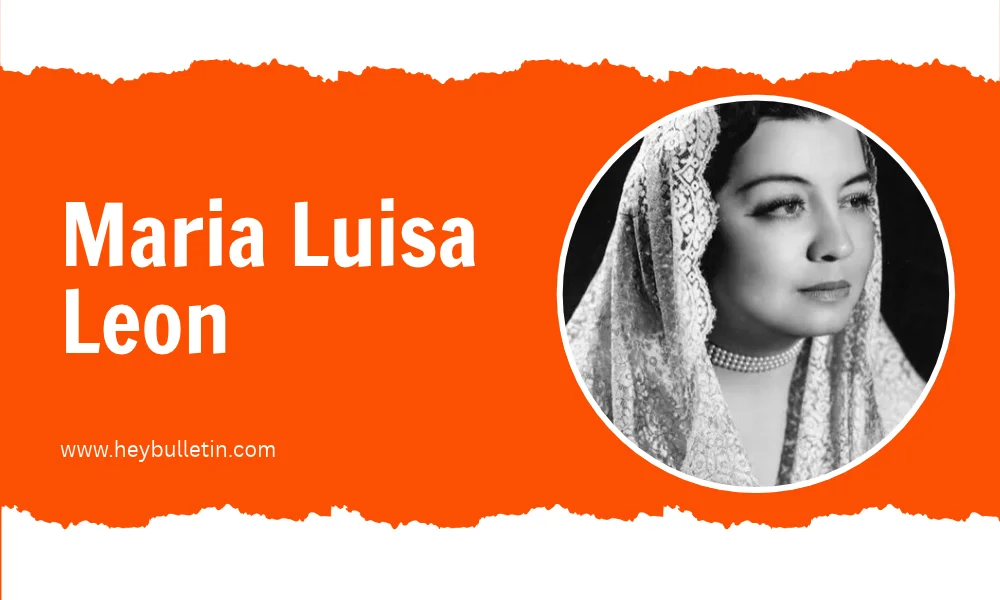
Maria Luisa Leon was the first and only legal wife of Pedro Infante, the Mexican singer and actor who became a legend of the Golden Age of Mexican cinema. This post follows her story from the beginning, when a young Sinaloa musician caught her attention with his voice, through the years of fame that reshaped their marriage. It looks at her influence on his image and musical direction, the singing dream she set aside to support him, and why she remained his legal wife until he died in 1957. It also covers her portrayal by Ana Claudia Talancón in the series Se llamaba Pedro Infante, the difference between dramatization and documented history, and how to spot invented biographies online.
Why María Luisa Leon is back in the conversation
Most people curious about her name today have probably just watched or heard about a biographical series. Se llamaba Pedro Infante dramatizes the singer and actor’s life, with actress Ana Claudia Talancón cast as María Luisa. Coverage of the casting describes her as the first and only wife of Pedro Infante.
That description carries a lot of weight. Infante’s romantic life was famously complicated, and the public conversation about him has often centered on the women who came later. Returning to María Luisa means going back to the beginning, before the fame, the film contracts, and the legend, when he was a young musician trying to make his way.
There’s a second reason for the interest. Audiences today are more curious about the people whose contributions were minimized in the original telling of a star’s life. Wives, partners, and collaborators who once appeared in a single line of a biography are now getting closer attention. Maria Luisa Leon fits that pattern well.
The beginning: a young singer in Sinaloa
The story starts in northwestern Mexico, in the state of Sinaloa, long before Pedro Infante became a household name across Latin America. Accounts of their romance say it began when Pedro was only 19, and that María Luisa was about ten years older.
The age gap is one of the most frequently mentioned details, and it’s worth pausing on. In the 1930s, a woman ten years older than her partner was unusual, and María Luisa did not fit the passive role often assigned to women in stories of that era. According to the retellings, she took the initiative.
She was reportedly struck by Pedro’s performance of Agustín Lara’s Como dos puñales and set out to meet him. She learned where he would be playing after his radio work, which led her to the Casino Atlético Humaya, where he performed with the orquesta Estrella.
The story is charming, and it says something about her character. She wasn’t a bystander waiting to be noticed. She heard a voice she admired, did some detective work, and showed up. As with many legends, details of this meeting may vary slightly depending on who is telling it, but the outline of the encounter is consistent across the coverage: a young singer, an admiring listener, and a spark that led to marriage.
Another report places their first meeting in Culiacán, and notes that María Luisa herself was interested in learning music and singing, a dream she set aside in order to support Pedro.
That detail is easy to skim past, but it may be the most important one in her story. She wasn’t only a spouse who happened to be near a rising star. She had artistic ambitions of her own, and she put them aside to support his career.
More than a spouse: her role in shaping a career
It would be easy to tell this story as one of simple devotion, with the loyal wife standing quietly behind a great man. The reporting suggests something more active. Ana Claudia Talancon, the actress playing her, has said María Luisa was a fundamental piece in Pedro’s career: she studied fashion and the most popular musical styles of the moment, and the famous mustache was reportedly her suggestion.
That last detail is memorable, because the mustache became part of Infante’s look. Whether it was strictly her idea or one of several influences is the kind of thing that’s hard to verify decades later, but it fits a broader picture. She seems to have functioned as an early adviser, someone who paid attention to how a performer presented himself and what audiences wanted.
Think about what a young musician needed at that stage of a career. He needed a repertoire that matched public taste. He needed an image that would stand out on a poster or a stage. And he needed someone who believed in the project before there was any evidence it would work. María Luisa appears to have supplied all three.
This is where the wife label starts to feel too small. In modern terms, we might call her part manager, part stylist, part creative consultant, and part emotional support. She didn’t hold any of those titles, but the functions were there.
Living with fame, and with its consequences
Success changed the shape of the marriage. As Infante rose to stardom, the demands of the film industry, the travel, the attention, and the temptations all grew. Reports note that although he had romances with other women and became a father through some of those relationships, he never managed to divorce María Luisa.
It’s an unusual legal situation, and it’s part of why her name endures. She remained his legal wife even as his personal life became a matter of public gossip. other accounts say that fame and infidelity threatened the marriage, yet she held firm and never considered leaving him.
It’s worth being careful here. We should be honest that these accounts come from entertainment coverage and dramatizations, not from a definitive scholarly biography, and that the inner life of a private person is never fully knowable from outside. Why she stayed, what she felt, and what the marriage was like day to day are questions each writer answers with a degree of interpretation.
What we can say is that her situation illustrates how differently public and private life could look for women of that era. Divorce carried heavy social and legal weight in mid-century Mexico. A wife’s position was tied to social standing, family expectations, and cultural norms in ways that are hard to appreciate today. Reading her choices through a modern lens can miss that context entirely.
The Golden Age backdrop
To understand María Luisa Leon, it helps to understand the world Pedro Infante was moving through. The Golden Age of Mexican cinema, roughly the 1930s through the 1950s, turned actors and singers into national symbols. Films like Nosotros los pobres made Infante a beloved figure, an everyman hero who sang, joked, and suffered on screen in ways ordinary audiences recognized as their own.
That kind of fame is intense. It shapes how a person is seen, and it reshapes the lives of everyone around them. Spouses of celebrities in this era were often expected to fill a narrow set of roles: gracious in public, discreet about problems, and supportive above all. Their own stories, careers, and dreams tended to be treated as secondary.
María Luisa’s abandoned singing ambitions are a small but telling example. In another time, the young woman who admired a radio singer’s performance so much that she tracked him down might have pursued her own musical career. Instead, her energy went into building someone else’s.
That isn’t meant as a judgment on her choice. Many people, then and now, make deliberate decisions to invest in a partner’s dream. But it’s worth noticing that the historical record celebrates the outcome, the star, far more than the person who helped create the conditions for it.
The dramatization and the problem of the polemical widow
one headline about the series calls her the polémica viuda, the controversial widow, of Pedro Infante. The word choice is revealing. Why should a widow be controversial? Because a public narrative formed around Infante’s romantic life, and María Luisa’s legal status made her a complicating figure in it.
After he died in a plane crash in 1957, the question of who held what place in his life became a matter of public argument. Different relationships, different families, and different claims on his legacy all competed for attention. In that kind of contest, the widow can easily be cast as an obstacle, a symbol of rules and paperwork in the middle of a romantic legend.
Dramatizations tend to smooth out that ambiguity, sometimes making her sympathetic and sometimes not. That’s the nature of the form. A series must condense decades into hours, invent dialogue, and give characters clear motivations. It’s a good entry point to a life, but a poor substitute for careful reading of the historical record.
So when you watch or read a portrayal of Maria Luisa Leon, treat it as an interpretation. Ask who wrote it, what they wanted the story to say, and what they may have left out.
A warning about biographies on the internet
Anyone reading about her online should be careful. Several pages that circulate under her name are not real biographies at all. They open with grand language about a remarkable journey of triumph and resilience, and then attach invented details to her name: a birth date and city that don’t match, a career in her field that is never named, generic claims about inspiring generations.
These pages appear to be automatically generated filler built to attract visitors. They tend to share the same tell: a lot of adjectives, no verifiable specifics, and no sources. one of them places her birth in Madrid in the 1980s, which flatly contradicts the fact that she was the older wife of a singer born in the early twentieth century.
Here’s a quick checklist for spotting this kind of content:
- No named sources. Real biographies point to interviews, archives, books, or reputable news coverage.
- Vague praise. Phrases like indelible mark and beacon of inspiration without any concrete achievement are a red flag.
- Facts that clash with other reports. If the birth date or nationality doesn’t line up with well-documented accounts, distrust the page.
- Boilerplate structure. A table of contents and frequently asked questions wrapped around almost no actual information is a common pattern.
If you’re reading about Maria Luisa Leon, favor established entertainment and news outlets, books about Pedro Infante, and archival material over pages that read like a template with her name dropped in.
other people who share the name
Names are messy. Maria Luisa Leon and close variants belong to several unrelated people. A historian of the ancient world at a university in the Balearic Islands is listed in academic directories under a similar name. other public figures named María Leon, including a Spanish footballer and a Mexican singer and actress, share similar names. And in the Dominican Republic, the Leon name is tied to a well-known cultural institution, the Centro Leon, although the person leading it is a different María.
None of these are the same person as Pedro Infante’s wife, and mixing them up is an easy mistake. If you’re writing about one of them, add context: a profession, a city, a project, or the name of a famous spouse. That small step avoids attaching one person’s story to another’s name.
Why her story is worth telling well
There are a few reasons her life keeps drawing attention, and they extend beyond one celebrity marriage.
It reframes the great man story. When a legend is told as one person’s triumph, the people who made it possible disappear. María Luisa’s involvement in his image, his music choices, and his early confidence is a reminder that careers are collaborative.
It highlights the cost of supporting someone else’s dream. Her own musical aspirations appear to have been sacrificed along the way. That trade-off is common, and seeing it clearly can prompt better conversations about whose ambitions get priority in a partnership.
It complicates simple moral labels. She has been described as both loyal and controversial. A more honest reading is that she was a person navigating a difficult situation with limited options, in a society that offered women in her position few good ones.
It shows how history gets written. Public memory tends to favor the dramatic, the romantic, and the scandalous. The steady, less glamorous work of building a career and holding a household together gets far less coverage, even when it matters more.
How to learn more responsibly
If this post has made you curious, a few approaches will serve you better than skimming a few headlines:
- Start with biographies of Pedro Infante. Because María Luisa’s life is so entwined with his, the best-documented accounts of her appear in books about him, often with names, dates, and sources.
- Read Spanish-language coverage. Most of the substantive reporting on her is in Spanish, from Mexican media outlets that have followed the Infante story for decades.
- Compare several accounts. When different sources agree on a detail, it’s more likely to be reliable. When they diverge, note it instead of choosing the most dramatic version.
- Treat dramatizations as starting points. Use the series to spark your curiosity, then check what you learned against non-fiction sources.
- Prefer primary material. Interviews, archived press, and family testimony, where available, carry more weight than secondhand summaries.
Conclusion
Maria Luisa Leon is best remembered as the woman who met a young singer in Sinaloa, believed in him before the world did, and stayed his legal wife through fame, complexity, and heartbreak. She reportedly influenced his image and musical direction while setting aside her own hope of singing. Her story has been told mostly in relation to a more famous man, and now, with a new series bringing her back into view, there’s an opportunity to see her more directly.
The honest version of that story admits its gaps. Much of what we know comes through entertainment reporting and dramatization, and the private truths of her marriage and her feelings are not fully documented. But even with those limits, the outline is clear and compelling: a resourceful, talented woman who shaped a legend from close range and, for a long time, received little credit for it.
The next time you see her name in a headline or a cast list, remember there’s a real person behind the character, someone whose choices deserve to be understood in their historical context, not just judged by modern standards or reduced to a plot point. Reading widely, checking your sources, and resisting the pull of generic online biographies is the best way to give her the fuller telling she has been owed for a long time.
Frequently asked questions
Who was Maria Luisa Leon?
The first and only legal wife of Mexican singer and actor Pedro Infante.
How did they meet?
Pedro was about 19 and she was roughly ten years older. She admired his singing and went to meet him where he performed in Sinaloa.
Did she have musical ambitions?
Yes. She wanted to sing but set that dream aside to support his career.
Who plays her in the series?
Ana Claudia Talancon se llamaba Pedro Infante.
Did Pedro Infante ever divorce her?
No. She remained his legal wife until he died in 1957.
