

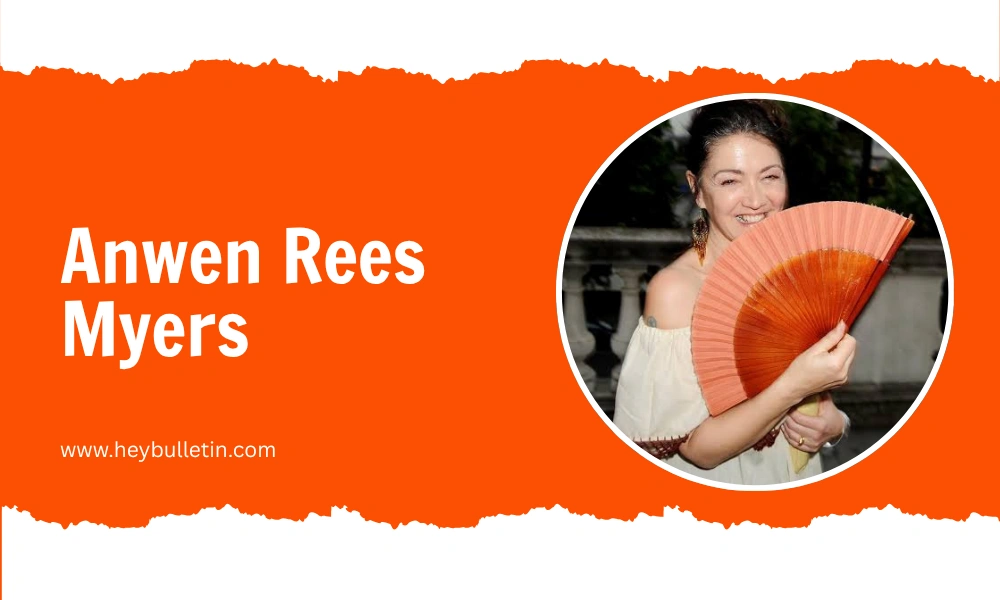
Anwen Rees Myers has spent most of her adult life working just off camera, building a career in film and television production while largely avoiding the kind of publicity that follows the actors and directors she has worked alongside. For a long stretch of the public’s awareness of her, though, Anwen Rees Myers has been known first and foremost as the fourth and final wife of the celebrated British actor Sir John Hurt. That framing tells only part of her story. Behind it is a woman with her own creative background, her own professional credits, and her own account of a marriage that by most descriptions was steady, affectionate, and largely private.
This piece looks at who Anwen Rees Myers is, where she came from, how her career in film developed, how she and John Hurt built their life together, and what is known about her since he died in 2017. Some details about Anwen Rees Myers, particularly around her personal life outside the marriage, remain thin in the public record, and this piece notes where that is the case rather than filling in gaps with assumption.
Early Life and Family Background
Public sources place Anwen Rees Myers’ birth on July 2, 1968, in the United Kingdom. She is often described as Welsh, and her father was Donald Rees, identified in several accounts as a designer from Pembrokeshire with a notable creative reputation of his own. Little detail exists publicly about her mother or any siblings, which is consistent with a broader pattern in Anwen Rees Myers’ life: even before she became known through her marriage, she kept her family circumstances largely out of view.
What is more consistently reported is that Anwen Rees Myers grew up with a strong grounding in the arts. Multiple profiles describe her early training as a classical pianist and singer, alongside an interest in acting. That combination of formal music training and performance experience is a common enough starting point for people who later move into production work, since it gives someone a working understanding of timing, performance, and the practical demands of putting a show together, even if they end up spending their career behind the camera rather than in front of it.
It’s worth flagging that biographical detail on Anwen Rees Myers’ childhood and adolescence is not extensively documented in mainstream press archives. Much of what circulates about this period of her life comes from lifestyle and entertainment sites written well after she became publicly associated with John Hurt, and some of it should be treated as a secondhand summary rather than independently verified reporting.
From Performer to Producer
Before settling into producing, Anwen Rees Myers worked as an actress and singer. That side of her career did not disappear entirely; IMDb credits her with a handful of on-screen appearances over the years, including a role in the 2014 comedy horror feature ChickLit and other small credits. But the more consistent and better-documented thread in her professional life is production.
Anwen Rees Myers built a career largely in advertising and commercial production before moving into film and documentary work. She has been credited as a producer on the television series Legends in 2007, and her subsequent producing credits include Regret Not Speaking (2011) and In Love with Alma Cogan, on which she served as executive producer around 2012 and 2013. She also worked as executive producer on the documentary Benjamin Britten: Peace and Conflict, which explored the composer’s life and pacifist convictions, and she took on a creative producer role for ChickLit in 2016. Industry databases like IMDb list her under her full name, Anwen Rees-Myers, with production credits spanning roughly a decade.
This body of work places Anwen Rees Myers squarely in the category of working film and television professional rather than simply a public figure by association. Her producing credits reflect an interest in British cultural and historical subject matter, from music documentaries to period drama, and they suggest someone who built relationships and a reputation within the UK production world over a sustained period, even as her name became more widely searched for reasons unconnected to that work.
Meeting John Hurt
The relationship that brought Anwen Rees Myers into wider public awareness began at a restaurant in London. In interviews given around the time of their marriage, Rees Myers described the encounter as close to love at first sight, noting that she had of course known of John Hurt for years as a public figure before meeting him in person. According to her own account, the two of them went out only a handful of times before recognizing that the relationship was significant. Both had been married before, and by her telling, that history made them deliberate about the pace at which they moved forward together.
For John Hurt, the relationship with Anwen Rees Myers came after a long and eventful romantic history. He had been married to actress Annette Robertson from 1962 to 1964, and prior to that had a long relationship with French model Marie-Lise Volpeliere-Pierrot, who died in a horse-riding accident in 1983 after the two had been together for roughly fifteen years. Hurt later married actress Donna Peacock, and then Jo Dalton, with whom he had two sons, Alexander and Nicholas. His marriage to Dalton ended in 1996, and he had a subsequent long-term relationship with writer and presenter Sarah Owens before meeting Anwen Rees Myers.
Anwen Rees Myers and John Hurt married in March 2005. For Hurt, it was his fourth marriage; for Rees Myers, reports differ slightly on the exact count of her prior marriages, with some sources describing the union as her second and others as her third, but there is general agreement that she had been married before meeting Hurt.
Marriage and Life Together
By most public accounts, the marriage between Anwen Rees Myers and John Hurt was a stabilizing one for the actor, who had a well-documented reputation for a turbulent personal life earlier in his career. Rees Myers herself addressed that reputation directly in interviews, saying she saw his hellraiser image as one facet of a man she also described as intelligent, sensitive, caring, and unafraid to be vulnerable. She spoke about the couple spending much of their time laughing together, describing a relationship built as much on companionship and humor as on romance.
Several accounts describe John Hurt giving up smoking and drinking during his marriage to Anwen Rees Myers, and Hurt himself reportedly described her as a calming influence on his life. The couple’s shared life, as described in later profiles, revolved around relatively simple pleasures: gardening, painting, long conversations, and time spent with a pet terrier at their home in Norfolk. That home in Norfolk would later become the place where Hurt died.
Anwen Rees Myers did not have biological children with John Hurt, but she became a stepmother to his two sons from his marriage to Jo Dalton, Alexander and Nicholas, sometimes referred to in coverage by the name Sasha. Photographs from the mid-2000s onward show the family together at public events, and Rees Myers was a regular presence alongside Hurt at industry functions, including appearances connected to his stage work, such as the 2012 Los Angeles opening of Krapp’s Last Tape, where she appeared backstage alongside Hurt and fellow cast and industry figures, including Gary Oldman.
Supporting John Hurt Through Illness
In June 2015, John Hurt announced publicly that he had been diagnosed with early-stage pancreatic cancer, saying at the time that he wanted to be open about the way he conducted his life and felt it appropriate to make a statement rather than let the news circulate privately. That October, reports indicated his cancer had gone into remission, offering a period of relief for Hurt and Anwen Rees Myers alike.
The remission did not last. John Hurt died on January 25, 2017, at his home in Norfolk, at the age of 77. Anwen Rees Myers confirmed his death in a statement, writing that it was with deep sadness that she had to confirm her husband, John Vincent Hurt, had died on Wednesday, the 25th of January, at home in Norfolk. Coverage of his death across outlets like the BBC and various entertainment publications consistently noted that he was survived by his wife of nearly twelve years, Anwen Rees Myers, along with his two sons, Alexander and Nicholas.
John Hurt’s career is among the more decorated in modern British film, spanning six decades and including Academy Award-nominated performances in Midnight Express and The Elephant Man, along with widely recognized roles in Alien, V for Vendetta, Tinker Tailor Soldier Spy, and the Harry Potter film series. He was knighted by Queen Elizabeth II in 2014, a recognition that came while he and Anwen Rees Myers were still together. His death was widely covered internationally, with much of that coverage naming Anwen Rees Myers directly as the person who had shared his final years and confirmed his passing to the public.
Life Since John Hurt’s Death
Public information about Anwen Rees Myers’ life since 2017 is limited, which is consistent with the low public profile she maintained even during her marriage. There is no widely reported information about remarriage, and she does not appear to have sought out media attention in the years since Hurt’s death. Entertainment databases continue to list her under her producing credits from the 2007 to 2016 period, but there is little indication in public reporting of major new production work credited to her since then, and it isn’t clear from available sources whether that reflects a step back from the industry or simply a lack of recent press coverage.
Some lifestyle sites have offered estimates of Anwen Rees Myers’ net worth, generally placing it in the range of one to two million dollars based on her career as a producer. It’s worth being cautious about figures like this, since they are not drawn from any official financial disclosure and appear to be informal estimates rather than verified numbers.
What is more firmly established is the way Anwen Rees Myers is remembered in connection with John Hurt: as a partner who, by most accounts, brought a sense of calm and stability to a man whose earlier life had been marked by loss and upheaval, and as someone who stood by him publicly and privately through his cancer diagnosis and eventual death. Interviews she gave during their marriage consistently describe a relationship grounded in mutual respect, humor, and a shared preference for a relatively quiet domestic life over the more visible aspects of Hurt’s fame.
A Career Worth Noting on Its Own Terms
It would be easy to reduce Anwen Rees Myers to a single role in someone else’s story, but her own professional path deserves recognition independent of her marriage. Her move from performance into commercial and documentary production reflects a career built over roughly a decade of credited work, spanning advertising, television drama, and documentary filmmaking on subjects ranging from a British composer’s pacifism to the life of a wartime-era singer. That is not a small body of work, even if it has not been extensively profiled in its own right.
Anwen Rees Myers’ story, in the end, sits at an intersection that is common enough in entertainment journalism: a working professional whose name became far more searched because of who she married than because of what she herself built. The available public record supports both halves of that story, the producer with genuine credits to her name and the wife who, by her own account, found something close to love at first sight with one of British cinema’s most respected actors, and who stayed by his side through the years that followed, including the hardest ones.
Conclusion
Anwen Rees Myers built a career in British film and television production long before most people had reason to know her name, and that career continued alongside, not because of, her marriage to Sir John Hurt. The public record shows a woman who moved deliberately from music and performance into producing, who found a late-in-life partnership she described in her own words as close to love at first sight, and who stood by her husband through illness, remission, and ultimately his death in 2017. What has followed since has been largely lived out of view, consistent with the privacy she maintained even at the height of public interest in her marriage. Taken together, the available sources point to a fuller picture of Anwen Rees Myers than the shorthand of John Hurt’s widow allows: a working producer with a decade of credits, a Welsh creative upbringing, and a marriage widely described as steady and affectionate rather than tabloid-driven.
Frequently Asked Questions
Who is Anwen Rees Myers?
Anwen Rees Myers is a British film and television producer and the fourth and final wife of actor Sir John Hurt, whom she married in March 2005.
What films and shows did Anwen Rees Myers produce?
Her credited work includes the 2007 series Legends, the documentary Regret Not Speaking, executive producer roles on In Love with Alma Cogan and Benjamin Britten: Peace and Conflict, and creative producer work on ChickLit in 2016.
How did Anwen Rees Myers meet John Hurt?
The two met at a restaurant in London. Rees Myers has described the meeting as close to love at first sight, though the couple took things slowly given that both had been married before.
Did Anwen Rees Myers and John Hurt have children together?
No. The couple did not have biological children, though Rees Myers became a stepmother to Hurt’s two sons, Alexander and Nicholas, from his earlier marriage to Jo Dalton.
What happened to Anwen Rees Myers after John Hurt’s death?
She confirmed his death in a public statement in January 2017 but has largely stayed out of the public eye since then, with no widely reported updates on remarriage or major new production credits.
